Managing personal finances effectively requires more than just creating a basic budget or tracking monthly expenses; it demands a strategic, self-aware approach. Applying a SWOT Analysis (Strengths, Weaknesses, Opportunities, and Threats)—a tool traditionally used in corporate planning—to your personal financial life provides a clear, structured roadmap to evaluate your current situation and achieve long-term financial independence.
1. Internal Factors: Strengths (S) and Weaknesses 
Internal factors are elements within your direct control. Identifying them honestly allows you to leverage your advantages while minimizing vulnerabilities.
Strengths (Internal Positive Attributes)
- Stable Income: Holding a reliable job, receiving a steady salary, or having recurring revenue streams.
- Financial Education: Understanding key concepts like compound interest, inflation, asset allocation, and tax optimization.
- Solid Credit History: Maintaining a high credit score that enables access to lower interest rates on loans or mortgages.
- Disciplined Savings Habits: Consistently allocating a fixed percentage of income toward savings or investments before discretionary spending.
Weaknesses (Internal Areas for Improvement)
- High High-Interest Debt: Carrying balances on credit cards or consumer loans that erode purchasing power over time.
- Lack of an Emergency Fund: Lacking 3 to 6 months’ worth of essential living expenses set aside in a liquid account.
- Impulsive Spending: Making unbudgeted purchases driven by emotions, lifestyle inflation, or social pressure.
- Absence of a Clear Financial Plan: Living pay-to-pay without defined short-, medium-, or long-term financial targets.
2. External Factors: Opportunities (O) and Threats (T)
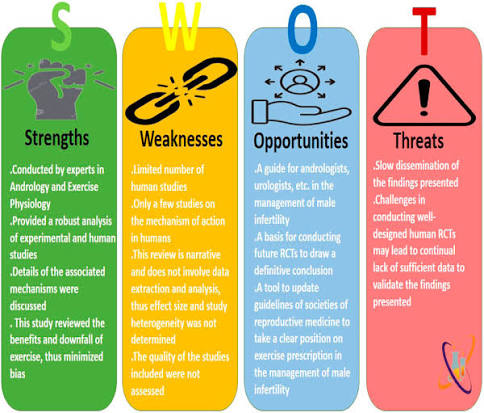
External factors originate from your surrounding environment, market trends, or macroeconomic conditions. While you cannot control them, you can prepare for and adapt to them.
Opportunities (External Favorable Conditions)
- Market Investments: Accessing accessible investment vehicles such as low-cost index funds, stocks, or real estate opportunities.
- Career Advancement & Upskilling: Acquiring high-demand professional skills to negotiate a raise, change industries, or land a higher-paying role.
- Side Ventures & Passive Income: Capitalizing on digital platforms or freelancing opportunities to build secondary income streams.
- Low-Interest Rate Environments: Refinancing existing debts to reduce interest burdens when market rates drop.
Threats (External Potential Risks)
- Economic Inflation: Rising prices that erode purchasing power and decrease the real value of cash savings.
- Job Insecurity or Economic Downturns: Market recessions or industry disruptions that threaten primary employment income.
- Unexpected Expenses: Unforeseen medical emergencies, home repairs, or family contingencies.
- Interest Rate Hikes: Increasing rates on variable-rate loans or credit products.
3. Formulating Your Personal Financial Strategy

Once you map out your SWOT matrix, combine these four quadrants to build actionable strategies:
- Strengths + Opportunities (SO): Use your financial discipline (Strength) to capitalize on market dips by investing in index funds (Opportunity).
- Weaknesses + Opportunities (WO): Use extra income from a side hustle (Opportunity) to pay off high-interest credit card debt (Weakness).
- Strengths + Threats (ST): Use your established emergency fund (Strength) to buffer against potential job market instability (Threat).
- Weaknesses + Threats (WT): Build an emergency cash cushion immediately (addressing a Weakness) to avoid relying on credit cards during an inflationary spike (Threat).
A personal financial SWOT matrix transforms abstract money management into a clear, strategic framework. By reviewing and updating your matrix annually, you can proactively adapt to economic shifts, eliminate financial vulnerabilities, and build sustainable wealth over time.

